




The latest push into high-end travel is taking place on the high seas, as cruise lines increasingly lean on luxury offerings.
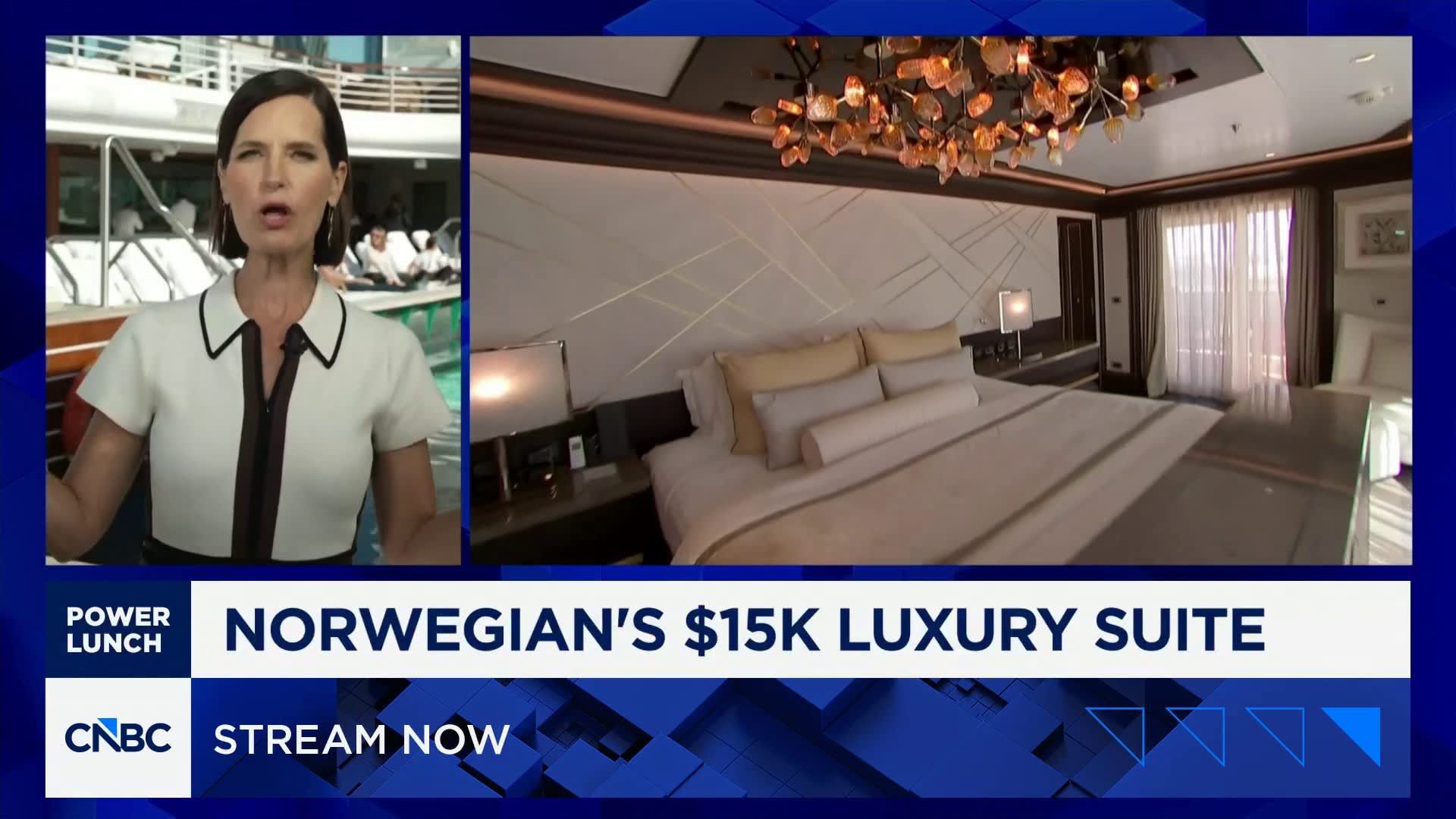
On Regent’s Seven Seas Splendor, an all-luxury ship, cabins cost anywhere from $1,800 to $15,000 per night for its top-of-the-line booking, the Regent Suite.
The difference is not just the roughly 5,100 square feet of space. The top-tier suite has a Steinway piano, a private dining room and a wraparound deck with a hot tub and a view comparable to the one from the ship’s bridge.
Multiple passengers wanted the suite for the Splendor’s 151-night global cruise that embarks in January, Regent told CNBC, and it is almost always occupied.
Regent is setting its sights even higher, as the cruise line plans to debut the Seven Seas Prestige in December, its first new ship class in a decade. Its top suite will cost $25,000 per night.
A bedroom in the Regent Suite on the Seven Seas Splendor.
Ryan Ruggiero | CNBC
While megaships with surfing and waterslides can carry more than 7,500 passengers, the smaller, elite ships — some carrying fewer than a thousand passengers — are powering profits for companies like Norwegian Cruise Line Holdings. The company owns luxury lines Regent and Oceania.
Norwegian CEO John Chidsey has said he’s focused on sharpening the luxury brands’ positioning, improving the products and guest experience, and strengthening their commercial performance.
Regent and Oceania, he said, are in good shape for 2027, though Chidsey did not break out metrics between the companies.
Living space in the Regent Suite on the Seven Seas Splendor.
Ryan Ruggiero | CNBC
Cruise competitors are also betting big on luxury offerings, investing in new ships and more specialized experiences.
Regent competes with established luxury cruise lines including Royal Caribbean’s Silversea and Carnival’s Seabourn, as well as newer entrants carrying hotel names into the market. Four Seasons, Aman and Orient Express are among the brands bringing luxury hospitality to yacht-style vessels.
The cruise industry projects the luxury cruise fleet will grow from 104 ships in 2026 to at least 130 by 2036.
And while global cruise passengers are forecast to increase about 11% between 2025 and 2028, according to the Cruise Lines International Association, or CLIA, the industry’s investment dollars are increasingly flowing to luxury and expedition brands, with orders rising for smaller ships and fewer berths through the next decade.
From 2020 through 2025, there has been a 71% increase in the number of luxury ships and an 84% increase in berths, according to CLIA. The orders indicate another 26% jump in the number of ships through the end of 2029 and a 32% increase in capacity.
A deck and hot tub attached to the Regent Suite on the Seven Seas Splendor.
Ryan Ruggiero | CNBC
Other hospitality companies are investing and expanding their uber-upscale offerings, too. Hotels, casinos, airlines, restaurants, spas and other travel and leisure companies see the trend: Affluent customers remain willing to pay for more space, personal service and distinctive experiences.
United Airlines this year launched its larger Polaris Studio suites with privacy doors and caviar service. American Airlines increased its lie-flat capacity and reported on Thursday that its premium passenger unit revenue rose 18.5% in the third quarter, compared with 14.4% in its main cabin.
Marriott’s second-quarter results showed luxury revenue per available room growing faster than the broader hotel business in the U.S. and Canada, rising 9.1% year over year, compared with 5% for all Marriott hotels in the region. In June, CEO Anthony Capuano told CNBC there’s an “almost insatiable appetite” for luxury travel.
Wynn Resorts, which caters almost exclusively to high-end customers, has opted to maintain its high room rates in Las Vegas even as visitation has slowed over the past year, rather than filling every room with travelers looking for a bargain.
A dedicated dining area in the Regent Suite on the Seven Seas Splendor.
Ryan Ruggiero | CNBC
Cracks forming in luxury?
Asked onstage at the Global Gaming Expo in September whether Wynn is extracting more profit from fewer customers, CEO Craig Billings said, “We will always focus on what’s the most comfortable experience for the customer and where can we drive the highest possible EBITDA.”
But offering luxury vacations doesn’t guarantee a company’s fortunes.
The Ritz-Carlton Yacht Collection, for instance, has struggled with occupancy despite major marketing campaigns and has accumulated nearly $700 million in losses since 2017, according to the Financial Times.
More competition in the space could undercut the perception of scarcity. As more companies add luxury products, they have to convince travelers that the experience is worth the price.
Las Vegas Sands reported earnings Wednesday that missed expectations for revenue and profit, hurt by the high-end segments in both Macao and Singapore.
“When the customers don’t show up, it’s a little problematic,” CEO Patrick Dumont said on the company’s earnings call.
Dumont said he couldn’t point to any single cause for the softness, adding, “perhaps people are not feeling as good about the market,” but he said he believes this quarter is an aberration.
CNBC asked Dumont during the NBA China Games in Macao on Oct. 9 whether luxury travel could become overcrowded.
In response, he pointed to the long-term wealth creation in Asia and said the challenge was making experiences customers want to return to.
“It’s not about, are there enough customers,” he said. “It’s, can we create enough of an interesting set of experiences where people find us indispensable in their lives.”


