



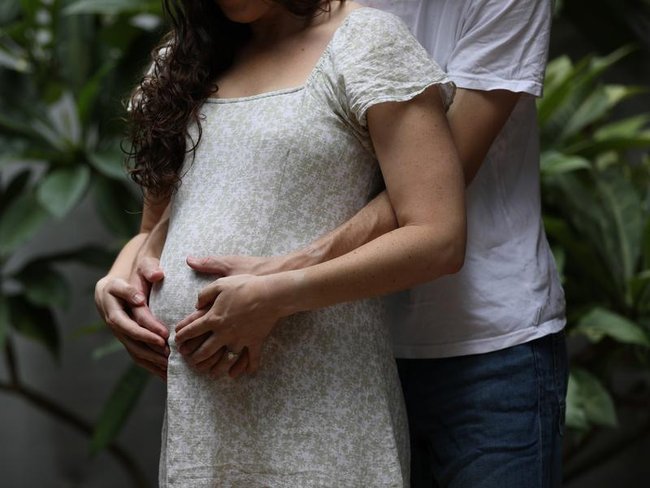
When Natalie Portman shared a heartwarming photograph of her baby bump at age 45, the response was overwhelmingly joyful.
But for many women watching on, high-profile pregnancies later in life raise more questions than they answer.
The stories can give hope to those struggling with the beast that is infertility, or reassurance to women who desperately want children but have not yet found the right partner or reached the right point in their lives.
Know the news with the 7NEWS app: Download today
But they can also create the impression the biological clock is not ticking quite as loudly as generations of women have been led to believe — potentially leading some women to delay seeking fertility information specific to their own age, health and circumstances.
The issue is, the public rarely knows whether a celebrity pregnancy happened naturally, through IVF, using embryos frozen years earlier, or with donor eggs — deeply personal details nobody is obligated to disclose, but ones that can dramatically change what their story means for another woman.
A growing trend
Internationally trained obstetrician, gynaecologist and fertility specialist Dr Anne Clark told 7NEWS.com.au there was no doubt more Australian women were having children later in life.
Behind that shift, she said, are women putting careers before family, cost of living concerns and lives that simply didn’t happen in a traditional order.
That change is reflected in the national figures, with Australia’s fertility rate falling to a record low of 1.48 births per woman as more people delay having children.
People are finding partners later, relationships are ending and new ones beginning, while some women reach their 30s or 40s without meeting someone they want to raise a child with.
Clark said she also sees women who have spent years in relationships believing children were part of their shared future, only to discover their partner never intended to become a parent.
“We certainly see situations in which women have been in a relationship for a considerable time. They’ve always wanted children, and the partner sort of finally fesses up that he never did,” she said.
“He was hoping ‘they’d grow out of it’.”

For other women, donor sperm has allowed them to pursue motherhood without waiting for a partner, while divorce and second relationships have also changed the age at which families are being created.
At the same time, fertility treatment has moved increasingly into the mainstream.
What was once discussed behind closed doors is now chronicled through podcasts, social media accounts and online communities, making IVF, egg freezing and donor conception part of a much more open conversation.
The celebrity effect
Portman recently shared an intimate photograph from her Paris apartment as she prepares to welcome her third child2, her first with French musician and producer Tanguy Destable.
“Counting the days until we meet you,” she wrote.
Her pregnancy follows a string of similar announcements. Perth-born Home And Away star Melissa George quietly welcomed her fourth son at age 49 in July, while Anne Hathaway announced in June she was expecting her third child with husband Adam Shulman at 43.

These women form a part of an increasingly visible picture of motherhood in the 40s.
For a woman approaching 40 who hasn’t met the right person, a couple struggling to conceive, or someone wondering whether they can afford to wait another few years, those images can be enormously powerful, but they can also be misleading.
Clark stressed there is no way of knowing how any individual celebrity conceived unless they choose to disclose it — and age alone should never be used to assume somebody underwent fertility treatment.
But she said that missing context can shape how other women interpret those pregnancies.
“You don’t know with the celebrity women,” she said.
“Have they had IVF in the past and they’re now using frozen embryos, which would have been frozen at the age they were made, or are they now using donor eggs?
“Not saying they’re not their own eggs, but they mightn’t be.” Different women can be pregnant in their 40s with completely different journeys behind them.
One may have conceived naturally. Another may be using an embryo created when she was 35. Another may have undergone multiple rounds of IVF. Another may be carrying a pregnancy conceived with a donor egg.
But from the outside, all the public sees is a bump.
“All the people see is all these people at 48 having their baby,” Clark said.
“It does start to give people unrealistic ideas of what’s achievable.”
And the concern is that hope could inadvertently convince someone she has years more to make a decision, only to discover later the options she assumed would be available to her have narrowed or disappeared completely.
The big IVF misconception
IVF has transformed what is possible for millions of families, but Clark said one of the enduring misconceptions around fertility treatment is that it provides an insurance policy against age.
Even among younger patients, treatment does not guarantee an embryo transfer will end with a baby.
“People think that, ‘Oh, well, I’ve had IVF, I’m certain to have a baby,’ and unfortunately, that’s not the case,” Clark said.
She said people can also become focused on a clinic’s pregnancy rate when the outcome that ultimately matters is the live birth rate.
IVF can improve the opportunity to conceive by allowing specialists to retrieve multiple eggs and potentially have multiple embryos to work with, rather than relying on the single egg typically released during a natural cycle — but it cannot make every egg viable.
The conversation around fertility and age also overwhelmingly focuses on women, something Clark said ignores half of the equation.
“The woman’s only half the baby,” she said.
Male fertility also changes with age, with Clark pointing to increased DNA damage as one factor that can make conception more difficult.

Individual circumstances matter too. Smoking, for example, can accelerate the depletion of a woman’s egg supply and bring menopause forward, while a person’s broader reproductive and medical history can affect their chances of conception.
That makes simple claims about a woman’s chance of becoming pregnant at a particular age difficult and potentially misleading.
Freezing time
For women who know they want children but aren’t ready to have them just yet, egg freezing can offer another option.
The technology has improved considerably, with Clark estimating frozen eggs now have about a 75 per cent survival rate.
But freezing eggs is not the same as freezing a future baby. The number collected matters, as does the woman’s age when they are frozen.
“At 35, you’re probably going to need about 15 eggs or so, and that will give you about a 75 per cent to 80 per cent chance of having a child,” Clark said.
The financial commitment can also be significant. Clark estimated egg collection and freezing at about $5000 out of pocket, depending on the clinic and circumstances, followed by storage costs of roughly $300 to $350 every six months.
Where there is a medical reason for fertility preservation — including ahead of some surgery that could affect the ovaries — Medicare may cover some of the cost.
For women considering their future fertility, Clark said testing can also help build a picture of where things stand, although no single test can provide a definitive answer.
The commonly used AMH blood test estimates ovarian reserve, but Clark jokingly refers to it as the “anxiety-making hormone” because a result can be easily interpreted as a definitive measure of a woman’s ability to have a baby when it isn’t.
She said an antral follicle count performed through ultrasound can also provide useful information about the number of follicles available at that point in time.
For some women moving into their 40s, the conversation may eventually turn to donor eggs.
Exactly when that becomes a more successful option than using a woman’s own eggs is individual, Clark said, but the crossover often occurs once women move into their 40s.
What the pictures don’t tell us
None of this diminishes the joy of becoming a mother after 40. Nor should women in their 40s look at statistics and assume motherhood is no longer an option for them.
The extraordinary advances made since Clark began specialising in fertility and reproductive medicine in 1985 mean families can now be created in ways that would have been unimaginable just decades ago.
But there is an uncomfortable contradiction at the centre of our increasingly visible celebration of later motherhood — we are seeing the happy endings more than ever before, without necessarily seeing the appointments, injections, and disappointments that often came before them.
Nobody owes the public that story, of course, but Clark believes greater openness about the realities of fertility treatment could help other women make informed decisions about their own futures.
Australian comedian Tanya Hennessy has been remarkably open about her journey to motherhood, sharing the crushing reality of infertility as she and husband Tom Poole spent years trying to become parents.
Her journey involved stage four endometriosis, multiple surgeries, seven rounds of IVF and close to $120,000 in fertility costs before she finally became pregnant at 39.
She welcomed their long-awaited daughter, Scottie Jack, on Christmas Day in 2025.
By the time Hennessy shared photographs of her growing bump, those who had followed her story knew what had come before.
They had seen the appointments, procedures, failed rounds, heartbreak, and uncertainty behind a pregnancy that, viewed as a single photograph, could otherwise have looked effortless.
That does not mean Portman, Hathaway, George or any other woman owes the public intimate details about how her child was conceived. Fertility treatment, donor conception and pregnancy are deeply personal.
But Hennessy’s story demonstrates why the context we don’t see can matter.
For Clark, the hope is that conversations about later motherhood encourage women who know they want children to find out what their options are while they still have as many of them as possible.
Otherwise, some may continue trying on their own until they “get past a time when fertility treatment would be of more help to them”.


