



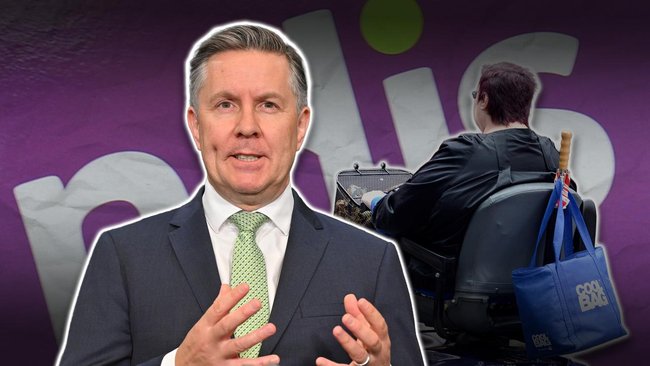
The National Disability Insurance Scheme cannot afford to be undermined by unsustainable growth in costs as Health Minister Mark Butler flags a complete overhaul of the system.
At the National Press Club on Wednesday, Butler outlined reforms to the $50 billion scheme including changes to who is eligible for support and tougher registration requirements for providers.
“Instead of costing more than $70bn in 2030, taxpayers will spend around $55bn,” Butler said.
Know the news with the 7NEWS app: Download today
This reduction in spending comes from a commitment from Butler to limit the scheme’s growth to 2 per cent a year over the next four years before expanding to 5 per cent growth after 2030.
The NDIS is currently growing at a rate of 10 per cent a year.Butler said registration would not be mandatory for all NDIS providers but admitted there needed to be improvements in who was profiting from the scheme.
“(You need) more ID to get into a licensed club than to be an NDIS provider,” he said.“That will change. Not every provider needs to be fully registered. We don’t need to monitor retail purchases from a chemist the same way we monitor close personal care of vulnerable people.“But we will expand categories of mandatory registration to include the higher-risk activities — personal care, daily living supports, and supports provided in closed settings.”

The federal government will also cut subsidised health cover for older Australians.
“Right now, we subsidise private health cover for Australians over 65 at a higher rate than other Australians,” Butler said.
“It means two households on the same income receive different levels of government support based only on their age … that’s simply not fair between generations. And it’s simply not the best way to spend precious taxpayer dollars.
“So this budget will return the rebate for older Australians back to the level paid for everyone else, and divert that money back into aged care to fund that package.
“Understandably, this won’t be a welcome decision for many, but it is the right thing to do to re-establish intergenerational equity in the rebate system, and also to free up funding that we need to provide more dignity and more care to older Australians.”
As part of the changes, standardised assessments will be rolled out, with a list of diagnoses no longer the sole standard of access.
The government is aiming to reduce the number of people on the NDIS from about 760,000 now to 600,000 by the end of the 2020s, lower than forecasts of more than 900,000 at current rates.
An advisory group, the disability community, and states and territories will help formulate the eligibility tests.
Those who don’t meet the benchmark for inclusion will be directed to other support services.
“(People have) been told this is the only program available or that this is the help their child needs,” Mr Butler said.“It is our responsibility to make sure that in the future, these Australians are pointed to the right place.”
The minister also announced that changes will bring the average cost of plans down to $26,000 per year, from $31,000 in 2026.
The plan spend will be in line with levels from 2023.
While the minister said the government had been seeking to reduce growth of the scheme, spending will be reduced to two per cent each year over the next four years, before going back to five per cent in 2030.
Previous changes had sought to get spending down to eight per cent growth.
A $200 million fund will also be set up to rebuild capability in the disability sector among community organisations.
NDIS to return to ‘sustainable’ levels
Earlier, Prime Minister Anthony Albanese said the scheme needed to carry out its original function to provide support to those with serious disabilities.
“What’s important is that it be made sustainable, because it’s too important to be undermined in terms of confidence in the scheme,” he told reporters in Sydney.
“What we want to do, though, is to make sure that Australians with disability, who the NDIS was aimed at, continue to receive really important support so they can fully participate in society.”
Greens disability spokesman Jordon Steele-John said the community was worried NDIS reforms would not result in positive changes for those receiving support.
“Disabled people and their families are sick of being used as political footballs,” he told ABC Radio.
“We’re in a situation right now where the government is saying we cost too much.
“People cannot understand … why a government facing a budget, which is ultimately always about choices, would choose to cut their services.”
People With Disability Australia president Jeramy Hope said the government needed to focus on making the scheme more efficient by reducing bureaucracy, rather than cutting eligibility to save money.
“Our community is scared and we want a surety that things are going to be OK,” he told AAP.
Changes announced in August will involve some children with autism being moved off the NDIS and into a separate program called Thriving Kids.
That program will begin rolling out from October and be fully implemented by January 2028.
On Tuesday, Butler and Treasurer Jim Chalmers briefed state and territory officials, who are reluctant to agree to any changes that would require them to pay more.
Queensland Premier David Crisafulli said he expected states and territories to push back against calls from the federal government for jurisdictions to do more of the heavy lifting.
“I want the federal government to deal with the system, deal with the rorters, but make sure that every single person who deserves support, deserves compassion, gets it,” he said.
“You’re going to see a chorus of states and territories from different sides of the political fence, and I’ve got a feeling most of them are going to be saying something very, very similar.”
Martin Laverty, one of the architects of the NDIS, said the scheme was not designed to meet the needs of everyone with a disability.
“It was designed, sadly, for those with the most significant, permanent and profound disabilities, and because other disability programs ceased, the NDIS was overwhelmed,” he said.
“Now it’s the chance to reset and to establish evidence-based programs for people with mild to moderate disability outside of the NDIS itself.”


