



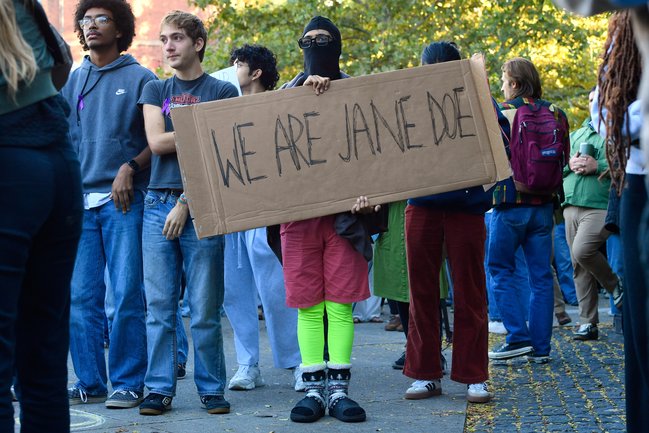
The term Jane Doe is often used as a place-holder for an unknown, unverified or concealed female identity.
So why is everyone talking about Jane Doe, and who is she?
This month, a US case at Cornell University thrust Jane Doe into the spotlight.
Know the news with the 7NEWS app: Download today
The woman, known as Jane Doe in legal documents to protect her identity, filed a lawsuit last month alleging she was drugged and raped by several men from the Chi Phi fraternity at the university in New York state in October 2024.
Doe said she had been drinking earlier in the evening before going to a fraternity house, where several men allegedly pressured her to take the drug ketamine and plied her with alcohol before advertising a “free” sexual encounter with her in a group message.

Doe claims Cornell failed to protect her and punish the alleged perpetrators.
The shocking allegations have raised questions about the university’s handling of the claims. Doe reported the assault to campus police three weeks later but, nearly two years on, no one has been criminally charged.
Doe’s suit has sparked uproar and criticism of the handling of her allegations by the institution and authorities.
Her lawyer says only two of the accused, now known as the “Cornell 7”, were expelled. The lawsuit alleges others were offered the opportunity to shorten their suspension by writing an essay.

Doe later left the university.
Social media movement in solidarity
The case has gripped the world, sparking the #IAmJaneDoe movement on social media and prompting a wave of solidarity with Jane Doe.
Users are posting the phrase to confuse online algorithms and counter attempts by internet sleuths to publicly expose the anonymous plaintiff’s real name.
Many users, predominantly women, are also using the hashtag to share their own experiences of sexual assault and harassment.
For Hannah Gartrell, 36, from Wollongong, NSW, the case inspired her to share her own experience of alleged sexual assault as a teenager.

Gartrell was a teenager when she drank too much alcohol at a friend’s house and her girlfriend had to put her to bed.
“In the morning I woke up and it was really clear that something had been done with my body,” Gartrell recalled.
“I found out through the course of the day that I’d been sexually assaulted overnight by one of the boys.
“I remember going to the bathroom and it being obvious that something had happened. I’d only just lost my virginity, so it was a really, really unusual sensation.”
Gartrell claims the boy who assaulted her had been bragging to other friends about what had happened.
“He made a disclosure to one my friend’s boyfriends about something he did to my body while I was unconscious and she let me know,” Gartrell said.
Gartrell said she believed she had been raped.
“Initially, I was so angry with myself. I just couldn’t believe I had drunk that much and had put myself in that position,” Gartrell said.
When victim-survivors don’t report
Gartrell told her mum, who took her to the doctor to be tested for sexually transmitted diseases and to be prescribed the morning-after pill.
“Mum had worked as a social worker for decades and she advised me against reporting the assault,” Gartrell said.
“She believed it would be re-traumatising, and it was unlikely to result in a positive finding.”
Over the years, Gartrell buried the incident deep within herself.
It wasn’t until 14 years later, when she was undergoing a procedure to remove pre-cancerous cells from her cervix, that the trauma resurfaced.
The invasiveness of the procedure triggered a post-traumatic response, forcing her to confront the alleged assault she had experienced as a teenager.
“At that point, I started to get treatment for PTSD and was finally able to deal with what had happened,” Gartrell recalled.
Confronting the trauma as an adult
Now, at the age of 36 and having confronted her trauma, does Gartrell regret not going to the police?
“I think I wouldn’t be human to not want consequences for someone who’s done something like that to you,” Gartrell said.
“But having said that, I don’t regret not going through with reporting it. I was not very resilient at the time and I think it would have really crushed me.”
Gartrell admitted she had spent years interrogating herself over what happened that night.
She often asked herself questions such as: Could I have done something that gave him a signal? Was I at fault in some way?
“I was so hard on myself, I can’t imagine going through that kind of questioning from a third party given how hard it was hear those things in my own head for the last 20-odd years,” Gartrell said.
More work needs to be done to break down barriers
The public conversation surrounding the Cornell University case highlights how sexual assault victims frequently delay reporting or do not report at all because they do not trust the institutions designed to protect and support them.
According to the Australian Institute of Health and Welfare, there was a 64 per cent increase in the rates of police-recorded sexual assault for women between 2010 and 2024 in Australia.
The institute also reported the majority of sexual assaults recorded by police in 2024 were perpetrated by someone known to the victim.
The research found this was due to a growing awareness and willingness to address sexual violence publicly, as seen in the social media movement sparked by Jane Doe’s case.

Educational programs about consent have also been introduced in schools and workplaces, alongside awareness campaigns, to further promote understanding and reduce barriers to addressing the issue.
However, not all sexual assaults are reported to police and as a result the data is an underestimate of sexual assaults in Australia, the research indicated.
According to the institute, reports have found work has been undertaken in recent years to improve police understanding of family, domestic and sexual violence, as well as police responses to reports of gendered violence.
However the reports also highlight responses are still inadequate and lacking in consistency.
Rates of reporting sexual violence, such as sexual assault, to police have historically been impacted by a range of factors including misconceptions about what constitutes sexual assault, mistrust of police, concerns relating to being believed and having to relive the experience.
Finding the courage to speak out
For Gartrell, receiving treatment after being diagnosed with PTSD has helped her find the courage to speak about her experience. She said the response from friends, family and strangers has been supportive and affirming.
“I started talking about it again most recently because of the Jane Doe case,” Gartrell said.
The mum-of-one posted her own “I am Jane Doe” on Instagram, joining countless women around the world who are speaking out about their experiences of sexual assault while helping conceal the victim’s identity.
“It’s kind of good, and bad, that there are just so many women sharing their own disclosures at the same time,” Gartrell said.
“There’s one part of me that finds that really affirming because I know I’m not alone but then at the same time, it’s just really tragic that this problem is just endemic, it’s everywhere.”
Gartrell said what angers her most about Jane Doe’s case, and cases like hers, is the “victim blaming”.
“We seem to hold women responsible for being in vulnerable situations rather than holding perpetrators accountable,” Gartrell said.
“Being vulnerable doesn’t make you responsible for being sexually assaulted, and I think that’s something that’s taken me a good 20 years to realise.”


