



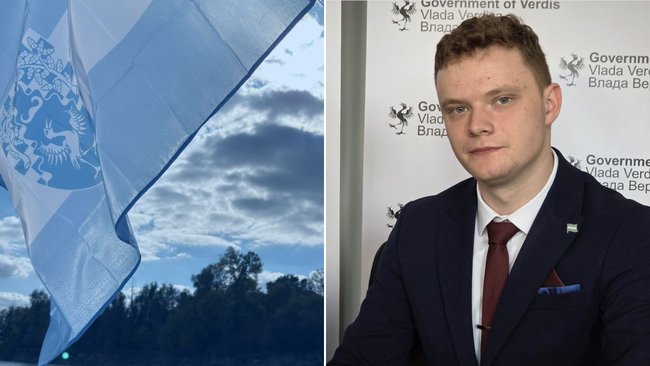
A young Australian has declared himself president of a self-styled country in Europe, issuing passports, setting up a government and building a following of hundreds of recognised citizens — despite having no control over the land he claims.
Daniel Jackson, 21, identified a narrow strip of forest along the Danube border between Croatia and Serbia in 2017, saying the break-up of Yugoslavia opened the door to his project as the land was left unclaimed and uninhabited.
WATCH THE VIDEO ABOVE: Australian creates country but gets deported
Know the news with the 7NEWS app: Download today
He believed the legal status of the land allowed for the creation of a new country, which he later named Free Republic of Verdis after the Latin word viridis, meaning green, to reflect its environmental focus.
Born in Upper Ferntree Gully in Melbourne and raised between Australia and the United Kingdom, Jackson became president of the project in 2019 — making him one of the youngest political leaders of a self-declared state.
“I didn’t entirely agree with the views of similar projects, so I started looking into whether there was any unclaimed land,” he told 7NEWS.com.au.
“I managed to find what is now Verdis.”
The 0.5sqkm territory, known as Pocket 3, sits at the centre of a long-running border dispute between Croatia and Serbia, where competing claims over historical and river boundaries have left sections of land in legal limbo — otherwise known as terra nullius.
The area has also drawn other would-be nation builders, including the self-declared Free Republic of Liberland, which claims a nearby parcel of disputed land along the same border.


Verdis was formally proclaimed on May 30, 2019, and describes itself as a proposed sovereign state in Southeast Europe, with English, Croatian and Serbian listed as official languages.
Jackson moved to expand the project in 2023, working with supporters to establish a presence on the land.
“We set up a government, provided humanitarian aid and even started a settlement,” he said.
The effort was quickly halted by Croatian authorities, who removed those involved and have since prevented access to the site, with Jackson among those detained.
“Croatia is just blockading it,” he said.
The Vatican-sized nation is now run from abroad, with Jackson dividing his time between the United Kingdom and Serbia, where a representative office has recently opened.
“Even while operating in exile, Verdis still has a responsibility for its citizens, just like any other country,” he said.
“A typical day for me is responding to journalists and foreign officials, managing the cabinet, and speaking to citizens and supporters.”
He has also taken part in surveying trips to the disputed territory and travelled to Ukraine on humanitarian missions with Verdis volunteers.
Interest in the “new state” has grown, with thousands of people applying for citizenship and several hundred citizens already recognised.
The organisation says its e-residency program has surpassed 4,000 participants as of April 6, 2026, many of whom are working towards full citizenship, after growing by about 300 per cent in just over five months from about 1,000 members.


The e-Residency program allows people to register businesses and begin a pathway to citizenship, but does not grant residency rights and operates on a paid model starting from about €29.99 a year.
For now, however, those citizens cannot live on the land.
The territory is only accessible by boat from Croatia, with visitors warned not to attempt to walk there due to potential landmines in the area.
“We expect to return to the land, and citizens have the right of abode in Verdis,” Jackson told 7NEWS.com.au.
The self-declared state describes itself as operating under a provisional government, with a set of “Basic Laws” functioning as an interim constitution until elections can be held.
Those laws grant the administration broad powers over citizenship, governance and the development of the state, with the president overseeing appointments and representing Verdis internationally.
Jackson said the broader aim is to establish a state with a strong focus on rights and neutrality.
“We want our country to protect freedom of speech, act as an unbiased mediator in international issues, and serve as a humanitarian hub,” he said.
He rejects comparisons to micronations, arguing Verdis has a legal basis under international law and is pursuing diplomatic engagement.
“We’re the only claimant to our land … we engage in international relations and have representative offices,” he said.
“To me, a micronation is an entity that claims a backyard and isn’t serious about actually being a state.”
However, legal experts dispute his view, pointing to the absence of a permanent population and effective control over the territory, both core requirements for statehood.
While Verdis presents itself as a serious state-building project, it reflects a broader Australian pattern of self-declared nations that have struggled to gain international recognition.
A University of Technology Sydney law study found Australia has one of the highest concentrations of such entities globally, with Australians behind many of the projects established over decades.
These projects have generally fallen into two categories: protest-driven breakaways formed in response to government decisions, or ideological or experimental “new countries” built around alternative political or social visions.
The most prominent example is the Principality of Hutt River in Western Australia, founded in 1970 after a dispute over wheat quotas.
It operated for decades with its own currency, passports and governing structures before being dissolved in 2020 following financial pressures during the COVID-19 pandemic.
Another example is Atlantium, established in 1981 by a group of teenagers in suburban Sydney and later run from an apartment serving as its symbolic capital.
It has since evolved into a long-running project grounded less in territorial control and more in what has been described as philosophical sovereignty.
None of these projects have secured formal recognition as sovereign states.
Jackson maintains Verdis is fundamentally different, describing it as a long-term effort focused on recognition, infrastructure and governance.
“The end goal is to have the blockade lifted, build infrastructure, and then hold elections under a new constitution.”
He said he does not intend to remain in power indefinitely.
“I don’t plan to run in those elections … I plan to step down and live as a normal Verdisian citizen,” he said.
Until then, the project continues to operate from abroad, without access to the land it claims but with a growing base of supporters.
“We are in this for the long run … it’s a matter of when, not if,” he said.


